
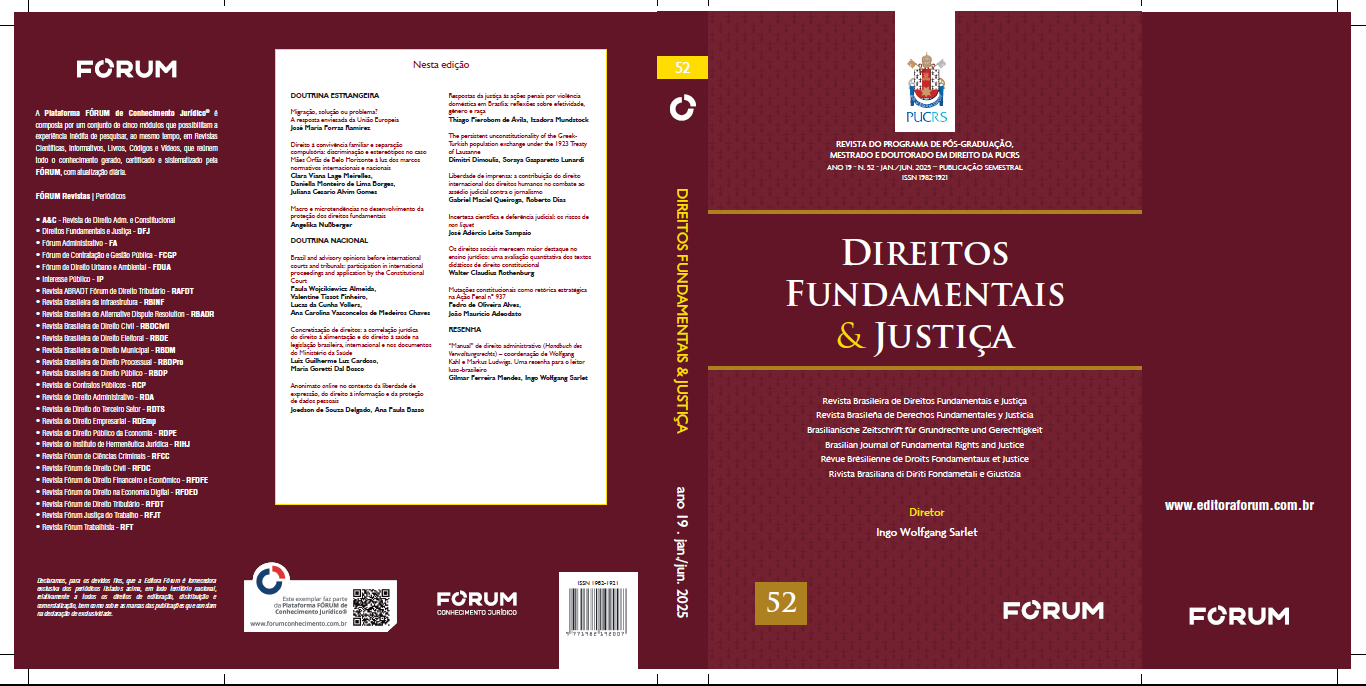
Anonimato on line no contexto da liberdade de expressão, do direito à informação e proteção de dados pessoais
DOI:
https://doi.org/10.30899/dfj.v23i52.1466Palavras-chave:
Anonimato online, Democracia digital, Liberdade de Expressão e de Informação, Plataformas digitais, Regulamentação da mídiaResumo
O desenvolvimento acelerado das tecnologias digitais requer uma regulamentação que considere novas relações jurídicas e melhore a legislação relacionada à defesa dos direitos humanos. É fundamental estabelecer restrições legais para garantir a segurança no ciberespaço e proteger os interesses nacionais. Este artigo analisa a regulamentação do anonimato na internet enquanto um direito autônomo e protegido por lei, diferenciando-o pela abordagem do direito comparado. A hipótese é que o direito ao anonimato possibilita que os indivíduos controlem o acesso à sua identidade, podendo pedir que dados relacionados a ela não sejam divulgados a terceiros. Esta pesquisa qualitativa, básica e exploratória utilizou uma metodologia dedutiva para analisar o anonimato na internet em relação à liberdade de expressão, ao acesso à informação e à salvaguarda de dados pessoais. A conclusão indica a necessidade de estabelecer critérios para o reconhecimento do direito ao anonimato; no entanto, a falta de adequação das leis em vigor que garantem essa proteção prejudica a prática eficaz desse direito.
Referências
ABREU, Jacqueline de Souza. Passado, presente e futuro da criptografia forte: desenvolvimento tecnológico e regulação. Revista Brasileira de Políticas Públicas, Brasília, v. 7, nº 3, p.24-42, 2017. DOI: https://doi.org/10.5102/rbpp.v7i3.4869.
ARAÚJO NETO, Francisco Martins de. A adequação e contribuição do modelo regulatório do comunitarismo de rede no combate às fake news sobre o processo eleitoral nas eleições de 2021. 348 f. Dissertação (Mestrado Profissional em Direito) – Instituto Brasileiro de Ensino, Desenvolvimento e Pesquisa, Brasília, 2022. Disponível em: https://repositorio.idp.edu.br/handle/123456789/3644. Acesso em: 28 set. 2024.
ASGARINIA, Haleh. Limiting Access to Certain Anonymous Information: From the Group Right to Privacy to the Principle of Protecting the Vulnerable. The Journal of Value Inquiry, p. 1-27, 2024. Disponível em: https://link.springer.com/article/10.1007/s10790-024-09980-x. Acesso em: 27 set. 2024.
ASENBAUM, Hans. Anonymity and democracy: Absence as presence in the public sphere. American Political Science Review, v. 112, n. 3, p. 459-472, 2018. DOI: https://doi.org/10.1017/S0003055418000163.
BARD, Petra et al. Unity and Diversity in National Understandings of the Rule of Law in the EU. (April 30, 2020). DOI: http://dx.doi.org/10.2139/ssrn.4090571.
BAYER, Judit. Liability of internet service providers for third party content. Victoria University of Wellington Law Review., v. 1, p. 1, 2008. Disponível em: https://www.wgtn.ac.nz/law/research/our-research/past-research-projects/internetnz-working-papers/Bayer.pdf. Acesso em: 29 set. 2024.
BENEDEK, Wolfgang; KETTEMANN, Matthias C. Freedom of expression and the internet. Updated and revised 2nd edition. Jouve, Paris: Council of Europe, 2020
BRASIL. [Constituição (1988)]. Constituição da República Federativa do Brasil de 1988. Brasília, DF: Presidência da República, [2016]. Disponível em: http://www.planalto.gov.br/ccivil_03/Constituicao/Constituiçao.htm. Acesso em: 27 set. 2024.
BRASIL. Lei nº 13.709, de 14 de agosto de 2018. Lei Geral de Proteção de Dados Pessoais (LGPD). Brasília, 14 de agosto de 2018. Disponível em: https://www.planalto.gov.br/ccivil_03/_ato2015-2018/2018/lei/l13709.htm. Acessado em: 10 mai. 2023.
BRASIL. Lei n. 13.105, de março de 2015. Código de Processo Civil. Brasília, 16 de março de 2015. Disponível em: https://www.planalto.gov.br/ccivil_03/_ato2015-2018/2018/lei/l13709.htm. Acessado em: 28 set. 2024.
BROIANO, Paulo Henrique Rocha; PEIXOTO, Graziela Filgueira; GOMES, Sebastião Edilson Rodrigues. O discurso de ódio: um olhar sob a ótica da garantia constitucional da liberdade de expressão frente as redes sociais. Revista Ibero-Americana de Humanidades, Ciências e Educação, [S. l.], v. 9, n. 4, p. 1157-1175, 2023. DOI: https://doi.org/10.51891/rease.v9i4.9306.
CASABONA, Carlos María Romeo. Anonymization and pseudonymization: the legal framework at a European level. In: The Data Protection Directive and Medical Research Across Europe. Routledge, 2017. p. 33-50.
CASTELLS, Manuel. Redes de indignação e esperança: movimentos sociais na era da Internet. Tradução: Carlos Alberto Medeiros. Editora Schwarcz-Companhia das Letras, 2017.
ÇꞮNAR, Özgür Heval. The Right to Privacy in the 21st Century and the European Court of Human Rights' Case Law. In: The Right to Privacy Revisited. Routledge, 2021. p. 30-55.
CIPPOLONI, Claudia. The right to anonymity. Overview of the institute and analysis of its evolution in the age of the web revolution. Humanities and Rights Global Network Journal, v. 5, n. 2, 2023. DOI: https://doi.org/10.24861/2675-1038.v5i2.112.
CHAUSSÊ, Wagner Santos da Cunha. Políticas de relacionamento, armazenamento e segurança cibernética de dados de clientes no setor bancário brasileiro: fundamentos legais e implicações tecnológicas. 2024. 167 f. Dissertação (Mestrado em Direito). Universidade Católica de Brasília, Brasília, 2024. Disponível em: https://bdtd.ucb.br:8443/jspui/handle/tede/3435. Acessado em: 28 set. 2024.
CONVENÇÃO EUROPEIA DOS DIREITOS DO HOMEM. Convenção para a Protecção dos Direitos do Homem e das Liberdades Fundamentais. Council of Europe: Strasbourg, France, 1950. Disponível em: https://www.echr.coe.int/documents/d/echr/Convention_POR. Acesso em: 28 set. 2024.
DELGADO, Joedson de Souza; BASSO, Ana Paula. Minando o ambiente seguro de vedação constitucional do anonimato na internet. Ponto de Vista Jurídico, Caçador (SC), Brasil, v. 12, n. 2, p. 84–110, 2023. DOI: https://doi.org/10.33362/juridico.v12i2.3217.
ERMOSHINA, Ksenia; MUSIANI, Francesca. Concealing for Freedom: The Making of Encryption, Secure Messaging and Digital Liberties. Manchester: Mattering Press, 2022. 274p. DOI: https://doi.org/10.28938/9781912729227.
GOMES, Wison. Internet e participação política em sociedades democráticas. Revista FAMECOS, [S. l.], v. 12, n. 27, p. 58–78, 2008. DOI: https://doi.org/10.15448/1980-3729.2005.27.3323.
IASULAITIS, Sylvia. Modalidades de participação política em websites eleitorais: uma análise de fóruns de discussão com uma proposta metodológica. Revista Debates, [S. l.], v. 6, n. 2, p. 173, 2012. DOI: https://doi.org/10.1177/146144481663997
HERT, Paul de; GUTWIRTH, Serge. Privacy, data protection and law enforcement. Opacity of the individual and transparency of power. Privacy and the criminal law, p. 61-104. Belgium: Oxford Antwerpen, 2006.
JARDINE, Eric. Tor, what is it good for? Political repression and the use of online anonymity-granting technologies. New media & society, v. 20, n. 2, p. 435-452, 2018. DOI: https://doi.org/10.1177/146144481663997.
JONASON, Patricia. The Swedish measures accompanying the GDPR. In: E-conference on National Adaptations of the GDPR. 2018. Disponível em: https://blogdroiteuropeen.com/wp-content/uploads/2018/06/sweden.pdf. Acessado em: 27 set. 2024
KAMINSKI, Margot E. Real masks and real name policies: Applying anti-mask case law to anonymous online speech. Fordham Intell. Prop. Media & Ent. LJ, v. 23, p. 815, 2012. Disponível em: https://ir.lawnet.fordham.edu/iplj/vol23/iss3/2/. Acessado em: 27 set. 2024.
KANGWA, Mukuka. Prevention of personally identifiable information leakage in ecommerce using offline data minimization and online pseudonymisation. 2022. 194f. Thesis (Doctor of Philosophy in ICT Security Engineering). University of Zambia, Lusaca, 2022. Disponível em: https://dspace.unza.zm/server/api/core/bitstreams/ae3f180e-9836-4aa3-b502-89906e1960bd/content. Acesso em: 28 set. 2024.
KUNDE, Bárbara Michele Morais; REIS, Jorge Renato dos. Aplicativo secret: somos todos invisíveis? um olhar constitucional sobre o diálogo entre anonimato e liberdade de expressão no ambiente virtual. Revista Eletrônica do Curso de Direito da UFSM, v. 11, n. 1, p. 226-248, 2016. DOI: https://doi.org/10.5902/1981369420731.
LEITE, Gisele. Judicialização da política ou ativismo judicial em face da pandemia de covid-19. Revista de Direito da Administração Pública, a. 6, v. 1, n. 2, p. 21-59, jul/dez,2021. DOI: http://dx.doi.org/10.47096/redap.v1i2.237.
LUCAS, Luciane. Garimpo de dados na rede: o uso da Internet como instrumento predictivo. Logos. [S. l.], v. 8, n. 1, p. 33-39, 2015. Disponível em: https://www.e-publicacoes.uerj.br/logos/article/view/14769. Acesso em: 26 set. 2024.
MAIA, Rousiley Celi Moreira. et al. Sobre a importância de examinar diferentes ambientes online em estudos de deliberação. Opinião pública, v. 21, p. 490-513, 2015. DOI: https://doi.org/10.1590/1807-01912015212490.
MALHEIRO, Emerson Penha; ROMÃO, Renato Evangelista. A evolução da prestação de serviços públicos na sociedade da informação. Revista Direito em Debate, [S. l.], v. 31, n. 58, p. e12421, 2022. DOI: https://doi.org/10.21527/2176-6622.2022.58.12421.
MARSHALL, Jill. Personal freedom through human rights law?: Autonomy, identity and integrity under the European convention on human rights. Leiden, Netherlands: Martinus Nijhoff Publishers, 2009.
MARTINS, Dayane de Oliveira. Estudo sobre a transformação de dados pessoais em dados pessoais sensíveis: análise da integração na coleta e de indícios do processamento. 2024. 131 f. Dissertação (Mestrado em Ciência da Informação) - Faculdade de Filosofia e Ciências, Universidade Estadual Paulista (Unesp), Marília, 2024. Disponível em: https://hdl.handle.net/11449/255143. Acesso em: 28 set. 2024.
MASFERRER, Aniceto. Looking Forwards to the Future of Dignity and Human Rights: New Generation Rights. In: The Making of Dignity and Human Rights in the Western Tradition: A Retrospective Analysis. Cham: Springer International Publishing, 2023. p. 151-188.
MEDEIROS, Paulo Henrique Ramos. Governo eletrônico no Brasil: aspectos institucionais e reflexos na governança. 2004. 315 f. Dissertação (Mestrado em Administração). Orientador: Tomás de Aquino Guimarães. Universidade de Brasília, Brasília, 2004. Disponível em: http://www.realp.unb.br/jspui/handle/10482/1544. Acesso em: 28 set. 2024.
MOYAKINE, Evgeni. Online anonymity in the modern digital age: Quest for a legal right. Journal of Information Rights, Policy and Practice, v. 1, n. 1, 2016. DOI: https://doi.org/10.21039/irpandp.v1i1.21.
MOSES, Lyria Bennett. Recurring dilemmas: The law's race to keep up with technological change. U. Ill. JL Tech. & Pol'y, p. 239, 2007. Disponível em: https://classic.austlii.edu.au/au/journals/UNSWLRS/2007/21.html. Acesso em: 27 set. 2024.
NACIONES UNIDAS. Asamblea General. A/HRC/13/37. Consejo de Derechos Humanos. 13º período de sesiones. Distr. general 28 de diciembre de 2009. Disponível em: https://documents.un.org/doc/undoc/gen/g09/178/07/pdf/g0917807.pdf. Acesso em: 27 set. 2024.
OLIVEIRA, Bryan Felipe de; PINTO, José Simão de Paula. Contribuições da LGPD Para Amenização dos Efeitos dos Mecanismos da Engenharia Social. REVES – Revista Relações Sociais, v. 5, n. 4, p. 14712-01e, 2022. DOI: https://doi.org/10.18540/revesvl5iss4pp14712-01e.
OLIVEIRA, Jordan Vinícius; LOPES, Marília Carneiro da Cunha. Considerações sobre anonimato, pseudoanonimato e criptomoedas. Revista Eletrônica Direito e Sociedade - REDES, v. 9, n. 1, p. 159-176, 2021. DOI: https://doi.org/10.18316/redes.v9i1.6749.
ORGANIZACIÓN DE ESTADOS AMERICANOS. Mecanismos internacionales para la promoción de la libertad de expresión. 2011. Disponível em: https://www.oas.org/es/cidh/expresion/showarticle.asp?artID=849&lID=2. Acesso em: 26 set. 2024.
PIMENTEL, Alexandre Freire. A acessibilidade ao processo eletrônico como um direito humano-fundamental: uma taxonomia sobre a neutralidade digital processual. Revista Direitos Culturais, v. 16, n. 40, p. 179-195, 2021. DOI: https://doi.org/10.20912/rdc.v16i40.618.
PORTELA, José Airton de Aguiar. Liberdade de expressão: limites intrísecos e colisões. 2020. 134f. Dissertação (Mestrado em Direito). Universidade Autónoma de Lisboa. Portugal. 2020. Orientador: Professor Doutor Alex Sander Xavier Pires. Disponível em: http://hdl.handle.net/11144/4687. Acesso em: 27 set. 2024.
POZHITKOV, Igor. Copyright and Neighboring Rights Protection in the Russian Federation. Review of Central and East European Law, volume 20, issue 1, pages 53-83. DOI: https://doi.org/10.1163/157303594x00058.
PRETTO, Nelson Luca; RICCIO, Nicia Cristina Rocha; PEREIRA, Socorro Aparecida Cabral. Reflexões teórico metodológicas sobre ambientes virtuais de aprendizagem. Debates em educação, v. 1, n. 1, 2009. Disponível em: https://www.seer.ufal.br/index.php/debateseducacao/article/view/31. Acessado em: 4 mai. 2023.
RENGEL, Alexandra. Privacy as an international human right and the right to obscurity in cyberspace. Groningen Journal of International Law, v. 2, n. 2, 2014. Disponível em: https://doi.org/10.21827/5a86a81e79532. Acesso em: 28 set. 2024.
SKORUP, Brent; HUDDLESTON, Jennifer. The Erosion of Publisher Liability in American Law, Section 230, and the Future of Online Curation. Oklahoma Law Review, v. 72, p. 635, 2020. DOI: https://doi.org/10.1109/ACCESS.2018.2836184.
SOKOLOVSKA, Ana; KOCAREV, Ljupco. Integrating technical and legal concepts of privacy. Ieee Access, v. 6, p. 26543-26557, 2018. Disponível em: https://digitalcommons.law.ou.edu/olr/vol72/iss3/4/. Acesso em: 29 set. 2024.
SUNKEL, Megan M. And the I (SP) s Have It... But How Does One Get It? Examining the Lack of Standards for Ruling on Subpoenas Seeking to Reveal the Identity of Anonymous Internet Users in Claims of Online Defamation. North Carolina Law Review, article 6, volume 81, number 3, page 1189, 2003. Disponível em: https://scholarship.law.unc.edu/nclr/vol81/iss3/6/. Acesso em: 29 set. 2024.
TEFFÉ, Chiara Spadaccini de; MORAES, Maria Celina Bodin de. Redes sociais virtuais: privacidade e responsabilidade civil. Análise a partir do Marco Civil da Internet. Pensar-Revista de Ciências Jurídicas, v. 22, n. 1, p. 108-146, 2017. DOI: https://doi.org/10.5020/2317-2150.2017.6272.
TINTO, Ana Rita Ramos Y Rio. Protecção de dados de saúde: Percepção e conhecimento dos Administradores Hospitalares acerca do novo Regulamento Geral de Protecção de Dados da União Europeia, 2018, 120f. Dissertação (Mestrado em Gestão da Saúde). Escola Nacional de Saúde Pública Universidade Nova de Lisboa. Portugal. 2018. Disponível em: https://run.unl.pt/bitstream/10362/58821/1/RUN%20-%20Disserta%C3%A7%C3%A3o%20de%20Mestrado%20-%20Rita%20RioTinto.pdf. Acesso em: 28 set. 2024.
UNITED NATIONS. O direito à privacidade na era digital. Relatório do Gabinete do Alto Comissariado das Nações Unidas para os Direitos Humanos. Nações Unidas A/HRC/51/17 Assembleia Geral Distr.: General 4 de agosto de 2022. Disponível em: https://is.gd/bsFe11. Acesso em: 27 set. 2024.
UNITED NATIONS. Report of the Special Rapporteur on the Promotion and Protection of the Right to Freedom of Opinion and Expression: note / by the Secretary-General. 21 p.: tables. [New York]: UN, 18 Aug. 2017. Disponível em: https://digitallibrary.un.org/record/1304394?v=pdf. Acesso em: 27 set. 2024.
Downloads
Publicado
Como Citar
Edição
Seção
Licença
Copyright (c) 2025 Revista Brasileira de Direitos Fundamentais & Justiça

Este trabalho está licenciado sob uma licença Creative Commons Attribution-NonCommercial-NoDerivatives 4.0 International License.
Para acesso ao conteúdo do periódico, favor entrar em contato com:
Editora Fórum
0800 704 3737
vendas@editoraforum.com.br
